Anyon braiding on three quantum computers
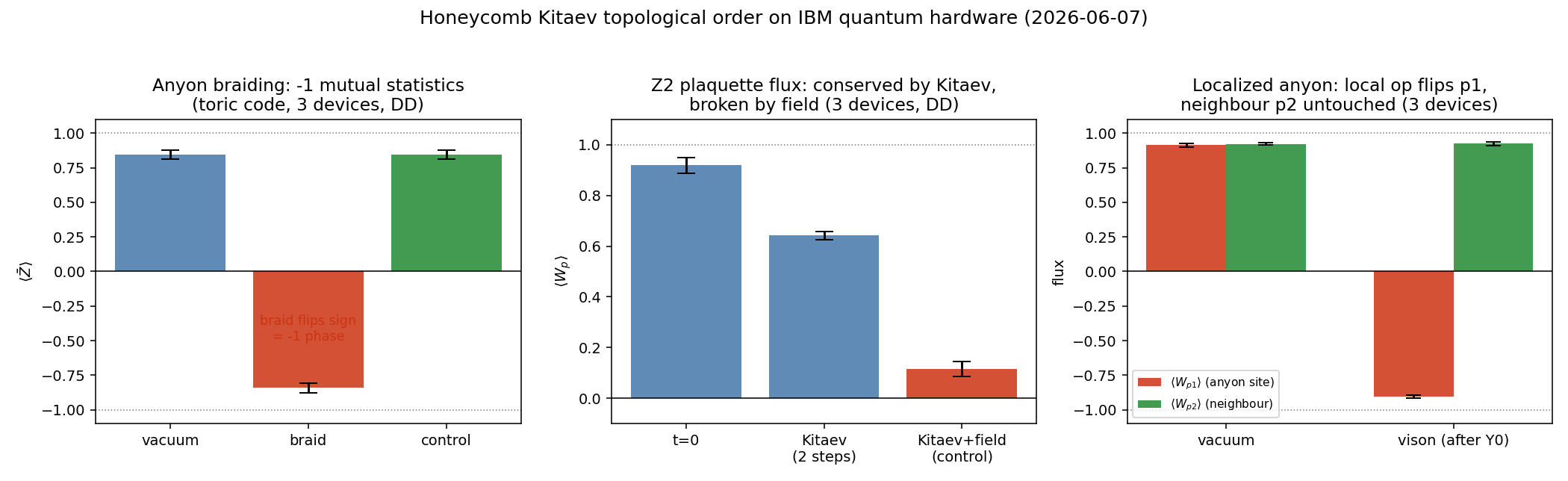
Topological order on the Kitaev honeycomb, measured on real hardware: conserved fluxes, a localized anyon, and the −1 braiding statistics — ⟨Z̄⟩ +0.845 ± 0.030 → −0.843 ± 0.035 against a +0.845 control — reproduced on ibm_marrakesh, ibm_kingston and ibm_fez with error bars.
Most topological-walk experiments use a single particle; most many-body experiments aren’t topological. This measures both at once, on superconducting hardware, simulator-gated before every submission, with a matched-depth random control beside every claim.
The minus sign — ⟨Z̄⟩ flipping from +0.845 to −0.843 while a control loop does nothing — is anyon exchange statistics, the primitive topological quantum computing is built on. Not new physics; measured by one person, honestly, on three independent machines.
Every number above is from a completed, logged run — controls, matched parameters, and error bars; negatives included. ← all research · next: the non-Abelian phase →