danielolliver.com / Research
Research
Hardware-verified quantum experiments and symmetry-aware machine learning. Every number comes from a completed, logged run — controls, matched parameters, and error bars; negatives included.
Papers: Circuit-level equivariance is code-dependent (June 2026) and The lattice's teeth (neural cellular automata) (July 2026), both preprints on Zenodo. All papers
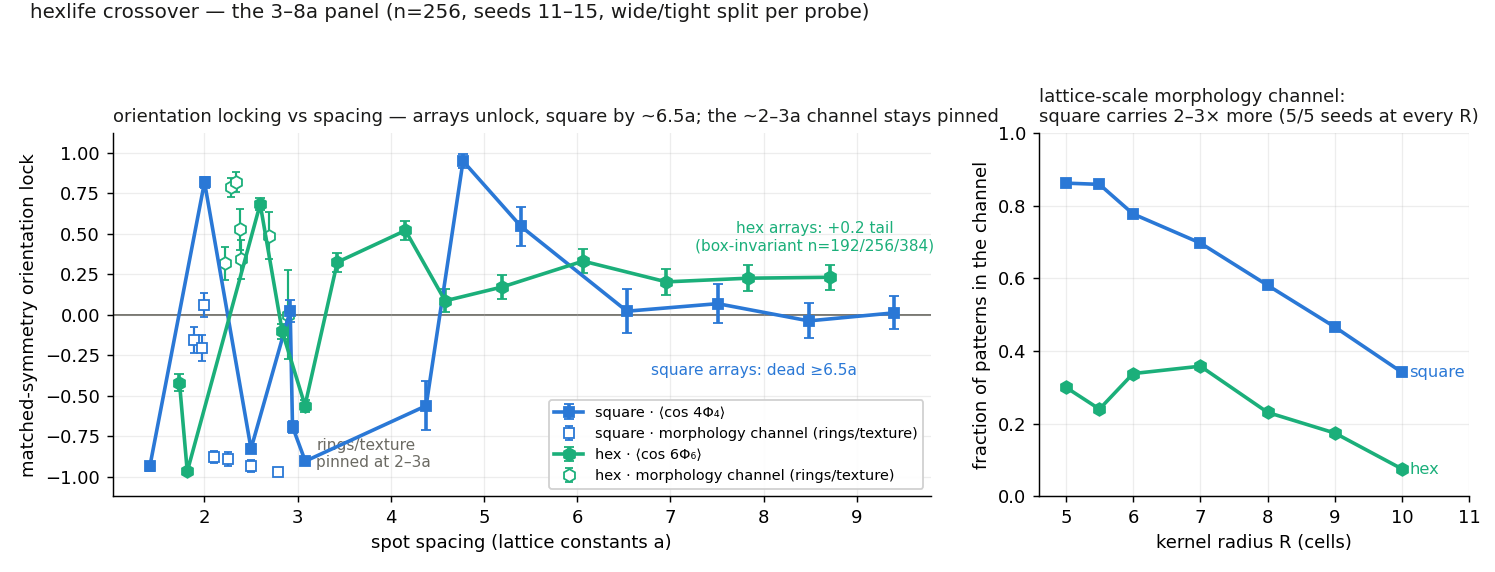
The lattice's teeth: when the substrate owns the pattern
The same pattern-forming physics on square vs hexagonal lattices, matched density and paired seeds: substrate-indifferent at normal scales — until, below ~3 lattice constants, the substrate sets the symmetry and locks orientation to its axes.
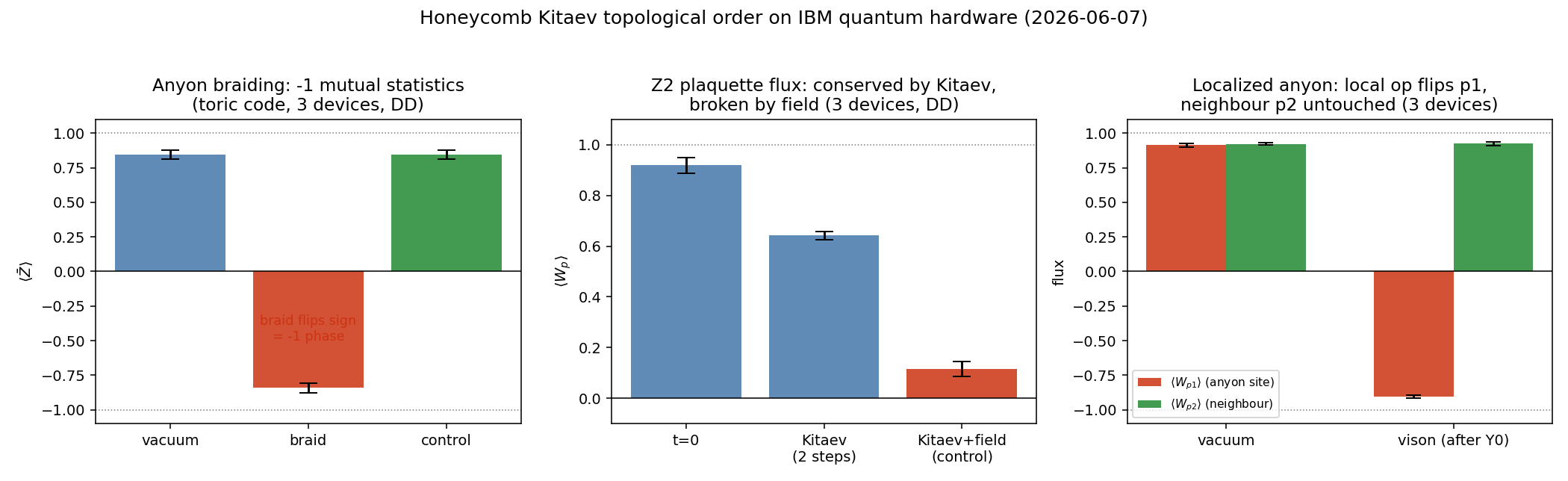
Anyon braiding on three quantum computers
Topological order on the Kitaev honeycomb, measured on real hardware — the −1 braiding statistics reproduced on ibm_marrakesh, ibm_kingston and ibm_fez with error bars.
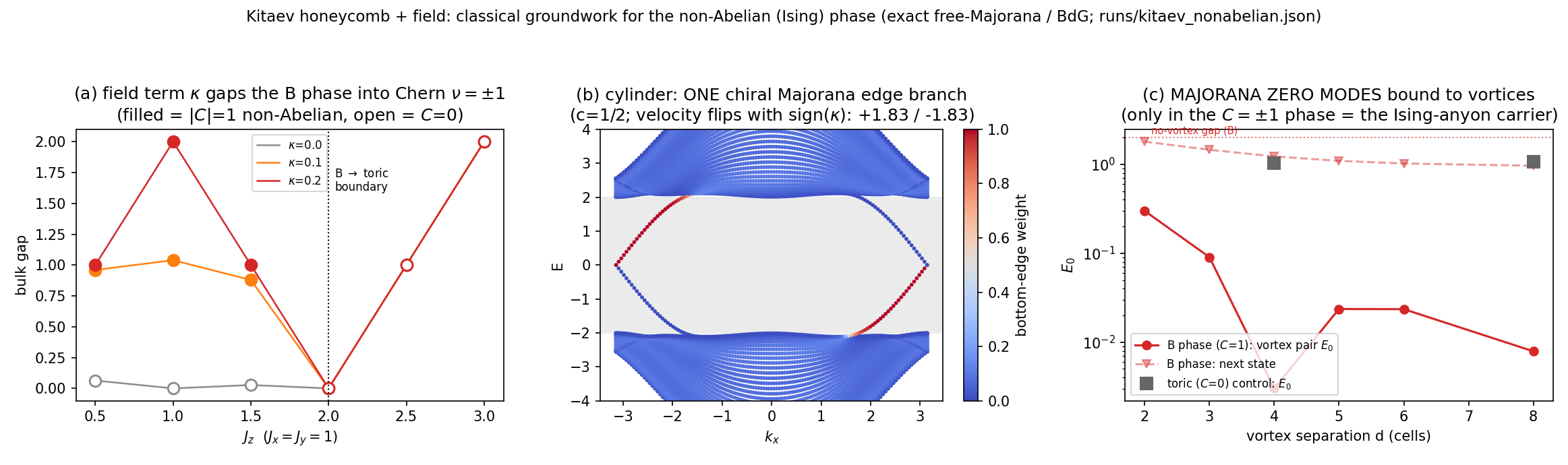
The non-Abelian phase, computed end to end
Kitaev + field, exactly: Chern number ±1, one chiral Majorana edge mode, and Majorana zero modes bound to vortices.
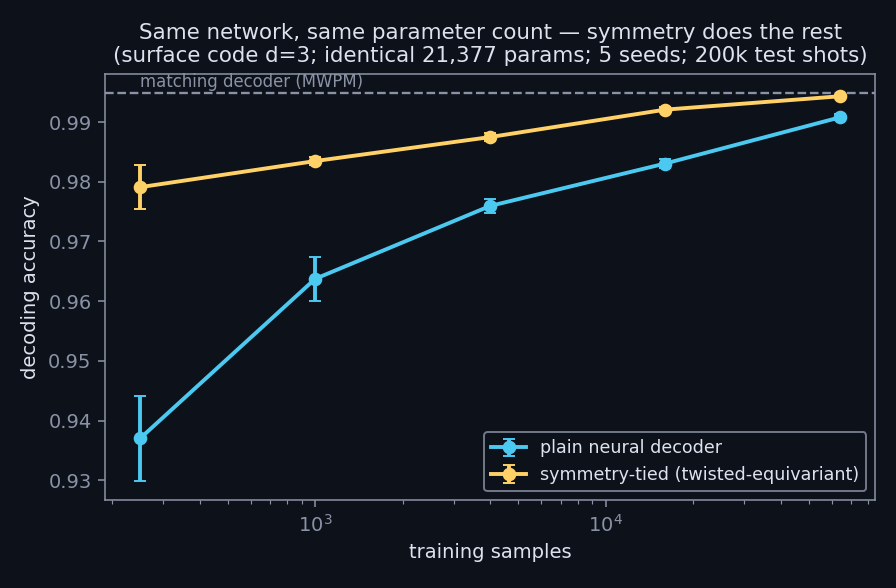
Symmetry-tied neural decoders for quantum error correction
An ML decoder tied to the surface code's exact symmetry — at identical parameter count — wins at every training size and is ~4× more sample-efficient.
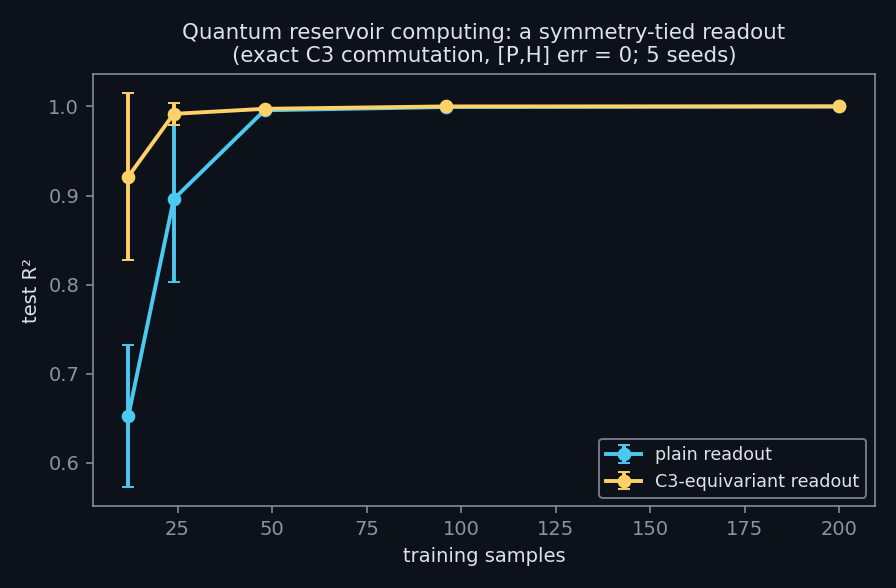
Equivariant readouts for quantum machine learning
A quantum reservoir with a symmetry-tied readout (exact C3 commutation): large sample-efficiency gains in the scarce-data regime.
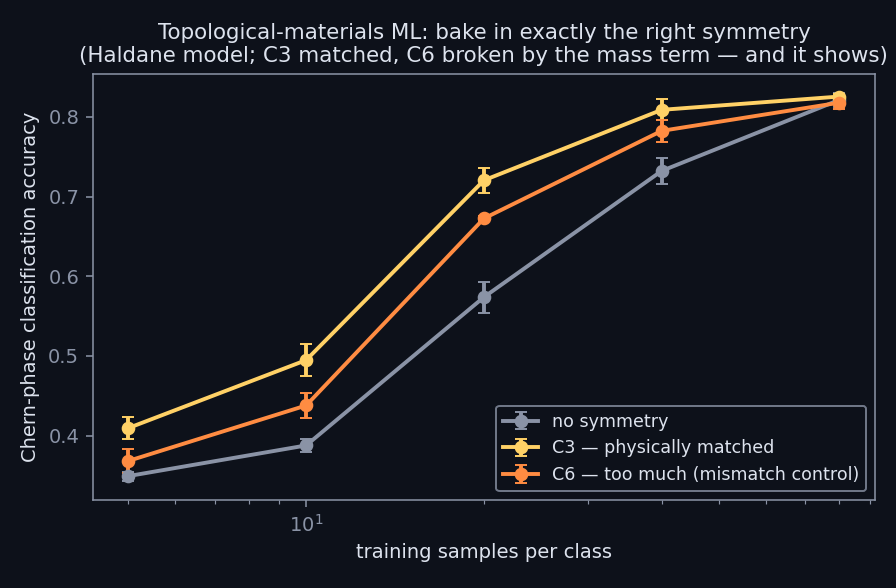
Topological-materials ML: match the symmetry, exactly
Classifying Chern phases of the Haldane model: the physically matched C3 prior wins at every scarce size, while the too-large C6 group loses.
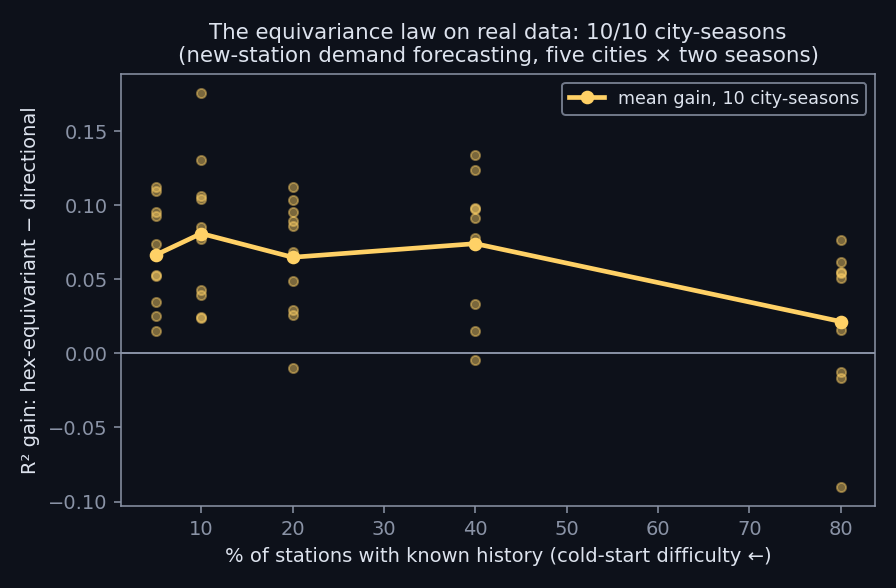
The equivariance law, held on real city data
New-station demand forecasting across five cities × two seasons: equivariant models pay exactly when the symmetry is present and data is scarce.