The equivariance law, held on real city data
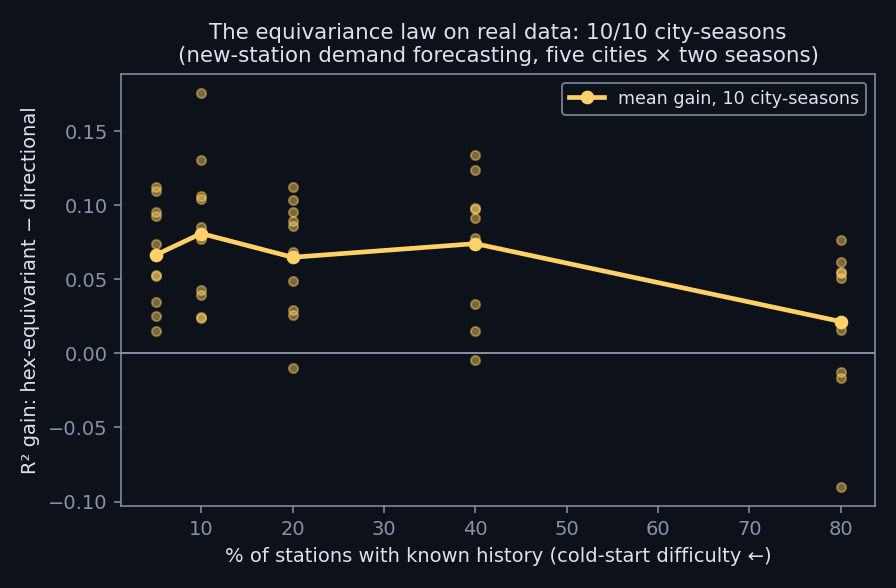
Equivariant models pay exactly when the symmetry is present and data is scarce. New-station demand forecasting across five cities × two seasons: the hex-equivariant model beats the directional one in 10 of 10 city-seasons, with the gain largest where history is thinnest.
In cold-start forecasting a brand-new station has no history of its own, so the spatial operator is the whole model — exactly where a symmetry prior can pay.
It does, in 10 of 10 real point-level bike-share city-seasons, and only there: the gain is largest where a cell’s history is thinnest and vanishes once data is abundant. Matched parameters, multiple seeds — equivariance pays if and only if the symmetry is genuinely present.
Every number above is from a completed, logged run — controls, matched parameters, and error bars; negatives included. ← all research · next: the lattice's teeth →