The lattice's teeth: when the substrate owns the pattern
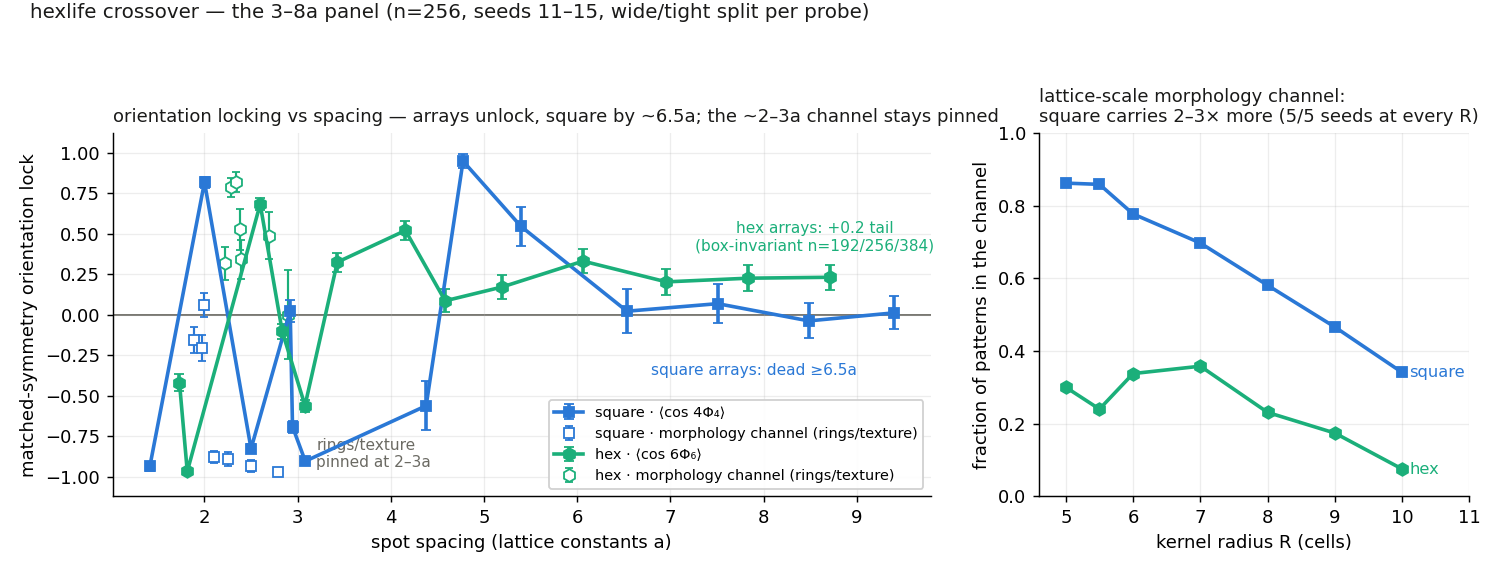
The same continuous pattern-forming system (Lenia-class) run on a square lattice and a hexagonal lattice at exactly matched cell density — same rule, same parameters, same random seeds; only the geometry differs. At normal scales the emergent patterns do not care which lattice they grow on. Below ~3 lattice constants, the substrate owns them — 11,946 measured patterns, replicated on independent hardware to the third decimal.
The method is the story. Five separate “discoveries” in one night were all measurement artifacts — sheared coordinates, raster contamination, a wrong wrap on a sheared torus, wrong connectivity, a granularity floor. Each looked like a large, significant effect; paired controls killed every one. What survived the hunt is a clean null: at normal scales the patterns even pack hexagonally on the square grid — hexagonal order is what the physics does, on any floor.
Pushed down toward the lattice scale, the null breaks — cleanly. Below ~3 lattice constants the substrate sets the packing symmetry class and locks the pattern’s orientation to its crystal axes (matched-symmetry lock up to |0.94–0.97|, while the wrong-symmetry channel sits at zero), and the locking direction flips with the ratio of pattern spacing to lattice spacing — textbook commensuration physics, the same class as atoms adsorbed on crystal surfaces. Pushed bigger, the locking rings through sign flips and dies on the square lattice by about 6.5 lattice constants. On the hexagonal lattice it never quite dies: a weak +0.2 lock, box-invariant across domain sizes (n=192/256/384), persists as far as measured (8.7a) — because the emergent patterns are themselves hexagonal, and only the hexagonal floor speaks their native symmetry. A second, unplanned observable rode along: a lattice-scale ring/micro-texture morphology channel that the square substrate sustains 2–3× more than hex, each locked in its own symmetry.
Bounded honestly: in the commensurate regime both substrates imprint their own symmetry with comparable strength — this is geometry transmitting at commensurate scale, and symmetry-matching at long range, not “hex wins.” The rig — matched-density Bravais lattices with paired controls — is going open source.
Every number above is from a completed, logged run — controls, matched parameters, and error bars; negatives included. ← all research · next: anyon braiding on real hardware →