Topological-materials ML: match the symmetry, exactly
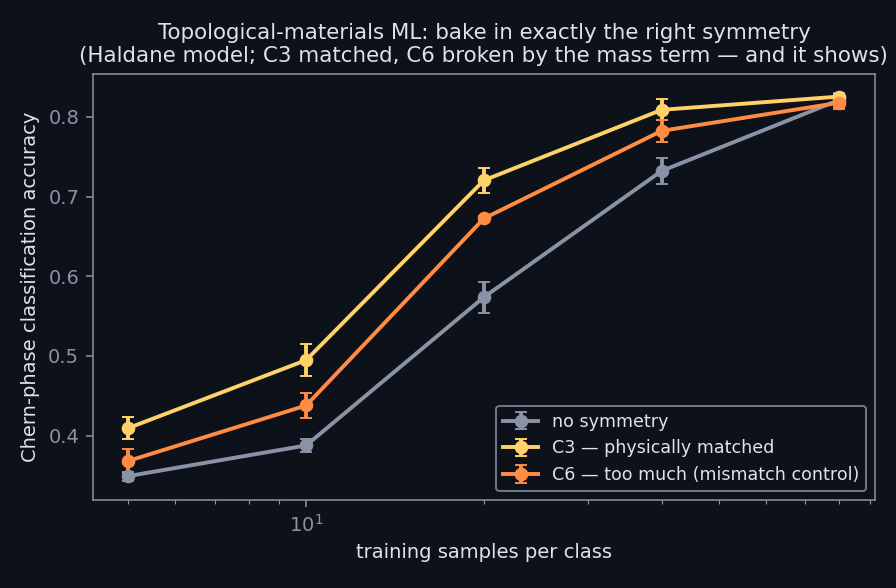
Classifying Chern phases of the Haldane model: the physically matched C3 prior wins at every scarce size, while the too-large C6 group — broken by the mass term — underperforms it everywhere. Built-in mismatch control; the law cuts both ways.
Materials ML bakes in E(3) or SO(3) symmetry, but nobody bakes in the honeycomb’s crystallographic C6/C3 point group — graphene’s own symmetry. That is an unclaimed corner, and a clean test of the equivariance law.
Classifying Chern phases of the Haldane model: the physically matched C3 prior is sample-efficient at every scarce size, while the larger C6 group — broken by the sublattice mass term — underperforms it everywhere. A built-in mismatch control; the law cuts both ways.
Every number above is from a completed, logged run — controls, matched parameters, and error bars; negatives included. ← all research · next: the equivariance law on city data →