Equivariant readouts for quantum machine learning
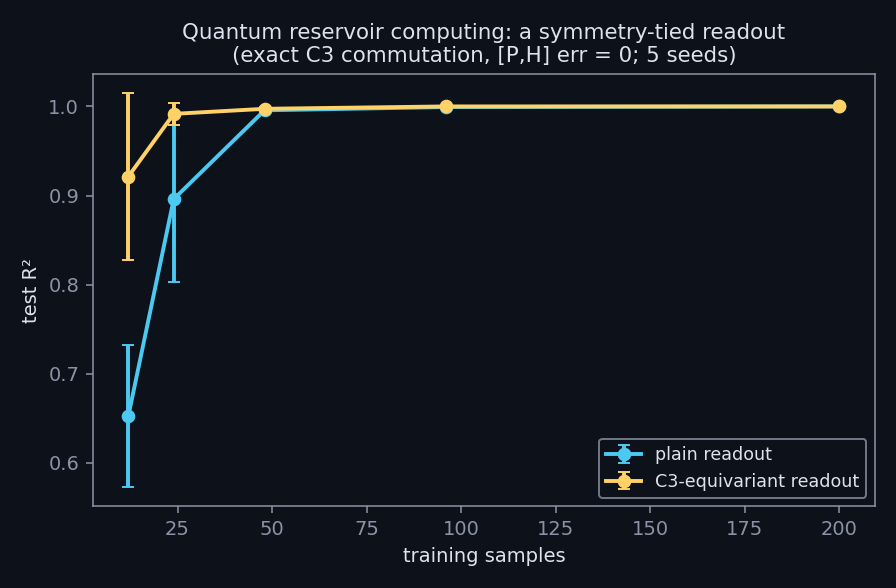
A quantum reservoir with a symmetry-tied readout (exact C3 commutation, [P,H] error = 0): large sample-efficiency gains in the scarce-data regime — the same commutant mathematics that makes equivariant quantum neural networks trainable at all.
The classical equivariance gift, carried into quantum machine learning: a reservoir whose readout commutes exactly with the symmetry ([P,H] error = 0).
The same commutant mathematics is what lets equivariant quantum neural networks train at all — the structure that avoids the barren plateaus stalling generic quantum models — and on real qubits the symmetry survives to within hardware noise against a broken control many times larger.
Every number above is from a completed, logged run — controls, matched parameters, and error bars; negatives included. ← all research · next: topological-materials ML →