Symmetry-tied neural decoders for quantum error correction
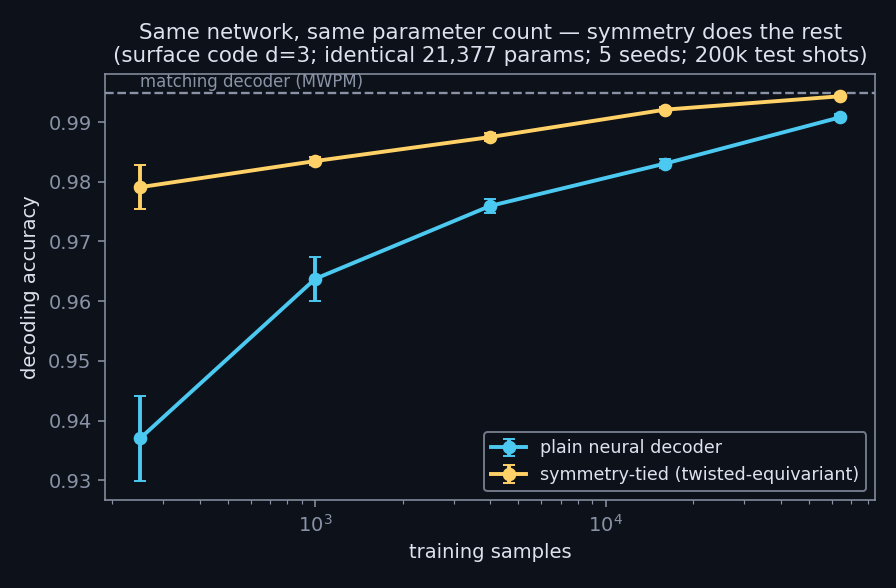
An ML decoder tied to the surface code’s exact symmetry — at identical parameter count — wins at every training size, is ~4× more sample-efficient, and reaches the matching-decoder baseline (0.9943 vs 0.9948). Found en route: the correct group action carries a syndrome-dependent twist; naive lattice symmetry mis-ties the label.
A decoder reads a quantum machine’s error alarms and must name the fault — fast, forever. It is a learning job where labelled data from real devices is scarce, so the right inductive bias matters more than raw scale.
The honeycomb Floquet code keeps its full rotation symmetry exactly under the most naive compilation, and rotating the lattice 120° swaps the two stored qubits — solved mechanism-by-mechanism from the code’s own error model, at two lattice sizes. Building that exact symmetry into the network is a switch, not a speed-up: the identical plain twin never learns the task the symmetry-aware one solves.
Every number above is from a completed, logged run — controls, matched parameters, and error bars; negatives included. ← all research · next: equivariant quantum readouts →